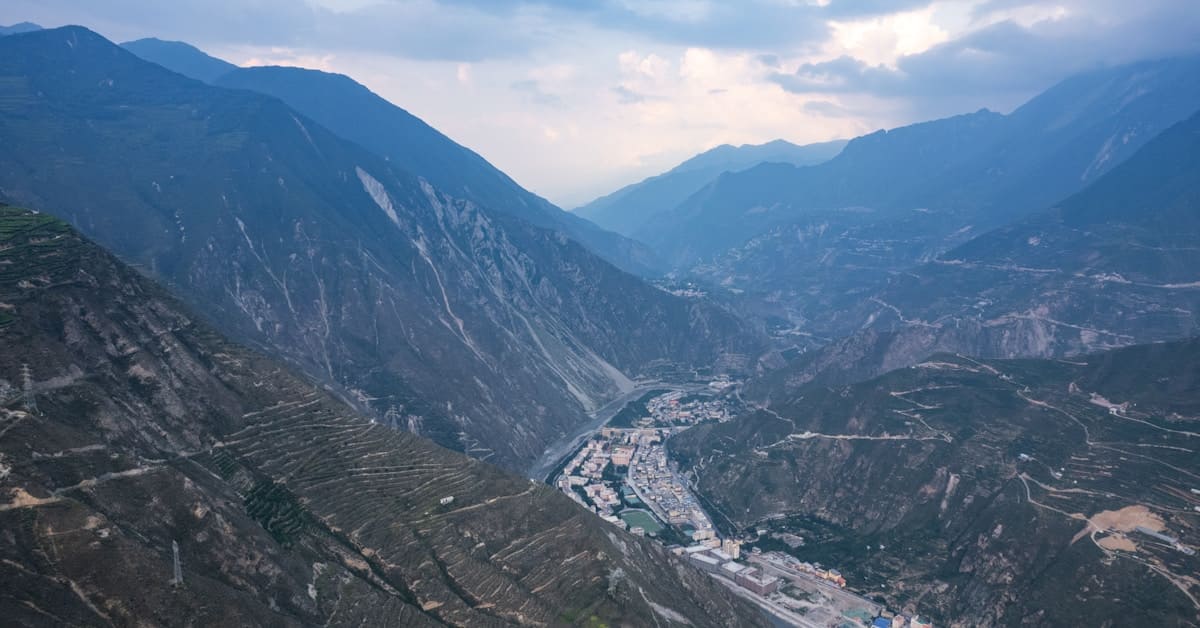
Sichuan trips fall into two camps. The first camp lands in Chengdu, sees the pandas, eats hot pot, and flies out three days later thinking they have done Sichuan. The second camp uses Chengdu as a base and then goes outward — Leshan, Mount Emei, Jiuzhaigou, the Tibetan grasslands beyond Songpan. The second trip is the real one. Chengdu is a great city, but it is the gateway, not the destination.
This guide covers the outward routes: how to do Leshan and Emei properly, when Jiuzhaigou is worth the long detour, the Songpan grassland loop most foreign visitors skip, and a few cultural pieces (Sichuan opera, the dialect, hot pot variants) that make the difference between a checklist visit and one you will actually remember.

Chengdu as Base: What You Actually Need There
Chengdu is the only place in Sichuan with a major international airport (Tianfu International, opened 2021, plus the older Shuangliu), so you will land here regardless. Three nights minimum to do the city itself: the Panda Research Base in early morning, the Wenshu Monastery district for teahouses and Buddhist architecture, the Jinli or Kuanzhai Alley areas for evening food, and one full day for either Mount Qingcheng or the Sanxingdui Museum (90 minutes north, the bronze masks are unlike anything else in Chinese archaeology).
The Chengdu city guide covers logistics; the Mount Qingcheng Taoist culture piece handles that specific day trip. After three days, you are ready to go further.
Leshan Giant Buddha: Boat vs Walk-Up
The Leshan Giant Buddha is 71 meters tall and carved directly into a sandstone cliff at the confluence of the Min, Dadu, and Qingyi rivers. It is the largest stone Buddha in the world. It is also a half-day side trip from Chengdu — 1h 20m by high-speed train (G-class) to Leshan station, then a 15-yuan taxi to the scenic area entrance.
The decision that matters: boat approach or walk-down approach? Both cost the same in total (boat ticket 70 yuan plus you can walk in for free; cliff walk 90 yuan park entrance) but they show you very different things.
The boat circles the front of the Buddha for about 15 minutes. You see the full scale at once — the head, the body, and the river setting in one frame. You stay on the boat the entire time. Good for limited mobility, families with small kids, or anyone short on time. Boats run roughly every 30 minutes from 8am to 5pm.
The cliff path takes you to the top of the Buddha’s head (next to the temple complex), then descends a narrow stair carved into the cliff face beside the right ear, ending at his feet. You see the detail — the curls of hair, the size of one toe, the drainage channels carved behind the body to prevent erosion. The descent takes 30–40 minutes; the queue in peak season can add another 60 minutes.
The honest recommendation: do both, in that order. Take the early-morning boat for the overall view, then enter the park and walk down for the detail. Total time including travel from Chengdu: 7 hours. Add another 2 hours if you want to see the Wuyou Monastery on the small island opposite.
Do not visit on Saturday or Sunday in peak season — the cliff stair becomes a 90-minute single-file shuffle. Tuesday or Wednesday is dramatically better.
Mount Emei: 1 Day or 2?
Emei Shan (Mount Emei) is one of the four sacred Buddhist mountains of China. It rises 3,099 meters from a base just 30 minutes south of Leshan, so most visitors pair the two as a 3-day Chengdu-Leshan-Emei loop.
One-day Emei (the most common version): bus from Baoguo Temple base area to Leidongping (the highest road point), cable car to within 15 minutes of the Golden Summit, see the gilded statue of Samantabhadra, descend the same way. Total walking: 90 minutes. Cost: 185 yuan park ticket plus 90 yuan round-trip bus plus 120 yuan round-trip cable car. Doable but it skips the actual mountain — you see only the summit pavilion.
Two-day Emei (worth it if you have the legs): day one, bus to Wannian Temple area, hike up through the monkey zone (manage your snacks — the Tibetan macaques here are aggressive and will mug visitors carrying visible food) past Qingyin Pavilion and the Pure Water Temple, sleep at one of the working monasteries (Hongchunping or Xixiang Chi, around 80–150 yuan per bed in a basic dorm). Day two, summit at sunrise, descend by cable car and bus.
The two-day version gives you the mountain that matters — the misty stone-stair walks between monasteries, the sense of the place as a working religious site rather than a viewpoint. Honestly, the Golden Summit alone is a forgettable photograph. The two days are the experience.
Best months: May–June and September–October. Avoid July–August (rainy, slippery, frequent cable car closures) and December–February (the summit drops below freezing and the upper trails ice over). Cloud sea at sunrise is most reliable in October.

Jiuzhaigou: Is It Actually Worth the Detour?
Jiuzhaigou Valley sits 450km north of Chengdu in Aba Tibetan Autonomous Prefecture. It is famous for cascading travertine lakes in turquoise, green, and yellow — the colors come from mineral content and algal life, not Photoshop. After the 2017 earthquake the park was closed for two years and reopened in 2019 with a strict daily visitor cap (currently 41,000, often reduced further in low season).
The hard part is getting there. Three options, all flawed:
- Fly Chengdu to Jiuzhaigou Huanglong Airport (JZH): 60 minutes by air, then a 90-minute bus to the park gate. Sounds fast — but the airport sits at 3,448 meters, altitude sickness on landing is common, and flights are heavily affected by weather. Cancellation rate in summer afternoons is 20–30%.
- Bus from Chengdu Chadianzi station: 10–12 hours via mountain roads. Cheap (180 yuan) but exhausting and weather-vulnerable.
- Drive (or hire a driver): 8–9 hours, breaks the journey at Songpan or Chuanzhusi for the night. The most flexible but also the most expensive (around 2,500 yuan/day for a driver).
So: Jiuzhaigou is worth it if you have a minimum of 4 days to dedicate (1 day each way plus 2 days in the valley), if you visit in October when the autumn colors are at their peak, and if you can avoid the first week of October (Golden Week makes the park borderline unusable). If any of those conditions fails, it is not worth carving out of a 10-day China itinerary.
For travelers building a longer route, the China Itinerary Guide shows how to slot Jiuzhaigou into a 14-day plan without sacrificing other regions.

The Songpan and Grassland Route Most Foreigners Miss
Songpan is an ancient Tibetan-Han border town 335km north of Chengdu, on the road to Jiuzhaigou. Most travelers blow through it without stopping. They are missing the most distinct cultural transition in Sichuan: within a single day’s drive, the food changes from Han Chinese hot pot to Tibetan butter tea, the architecture shifts to stupas and chortens, and the landscape opens into the Zoige grasslands at 3,500 meters.
The classic Songpan add-on is a 2–3 day horse trek into the highland lakes (Erdaohai, Mounigou) operated by the Shunjiang Horse Treks cooperative in Songpan town. About 800–1,200 yuan per day all-inclusive: horse, guide, tents, three meals. The cooperative has been running these treks for foreign travelers since the early 2000s and is well-organized.
Combine Songpan with Jiuzhaigou: arrive Songpan day 1, do a one-day horse trek day 2, push on to Jiuzhaigou day 3, two days in the park, then loop back through Songpan or push further west toward Langmusi and the Gansu border. That is a 7–8 day route that most package tours never touch.
The altitude is real. Songpan sits at 2,800m, the grasslands above at 3,500m, and the Jiuzhaigou Huanglong area at 3,500–4,000m. Acclimatize for at least a day, drink more water than feels reasonable, and skip alcohol on arrival night. Diamox is over the counter at any pharmacy in Chengdu if you want to be cautious.
Sichuan Opera and the Face-Changing Show
Sichuan opera (chuanju) is its own regional tradition, distinct from Beijing opera in singing style, accompaniment, and theatrical effects. The famous trick is bian lian — face-changing — where performers swap painted silk masks in fractions of a second, the mechanism a closely guarded secret passed through master-apprentice lines.
Where to see it: Shufeng Yayun teahouse in Chengdu‘s Cultural Park is the long-running tourist-friendly venue, 150–300 yuan depending on seating, nightly at 8pm. The show is a 90-minute variety format: shadow puppetry, hand shadows, a comedy skit, an erhu solo, and the face-changing finale.
The honest take: it is a tourist show, designed for short attention spans and limited language. That does not make it bad — the face-changing is genuinely impressive in person, and the variety format works as an evening’s entertainment after a heavy day. Don’t expect a full classical opera; for that, the Jin Jiang Theatre occasionally programs longer works in Sichuan dialect, but availability is irregular.
Sichuan Dialect: Small Notes That Help
Sichuan Chinese (sometimes called Sichuanese or Chuanhua) is a distinct dialect of Mandarin — about 75% mutually intelligible with standard Mandarin, but enough tonal and vocabulary differences that you will mishear things. A few useful notes:
- “Mei wenti” (no problem) in Sichuan is often pronounced closer to “mei wen ti-ya,” with a softer trailing particle. Same meaning.
- Numbers shift: “shi” (10) sometimes sounds like “se.” If you are bargaining and the number sounds wrong, ask the vendor to type it on a phone calculator.
- “Hao chi” (delicious) is often replaced by the local “ba shi” — same compliment, more authentic.
- Don’t worry about it. Anyone in the hospitality or tourism business speaks standard Mandarin, and English is increasingly common in central Chengdu, Leshan, and the Jiuzhaigou tourist area.
The deeper personal Sichuan travel notes cover smaller towns and food details I have not repeated here.
A Workable 7-Day Sichuan Route
Days 1–3 Chengdu: arrival, panda base, Wenshu district, Mount Qingcheng day trip, evening hot pot in the Yulin neighborhood (not the tourist Jinli version).
Day 4 Leshan: early G-class train, boat then cliff walk at the Buddha, train back. Evening Sichuan opera in Chengdu.
Day 5 Mount Emei (start): bus from Chengdu, walk up from Wannian Temple, sleep at Hongchunping monastery.
Day 6 Mount Emei (summit + descent): sunrise at Golden Summit, descend via cable car, late train back to Chengdu.
Day 7 (optional add-on): Sanxingdui Museum if your flight is late, or buffer day for shopping and meals you missed.
To add Jiuzhaigou, extend by 4 days minimum (10–11 day total). To add the Songpan grassland horse trek, extend by 5–6 days.
Common Mistakes vs What Actually Works
| What first-timers get wrong in Sichuan | The fix |
|---|---|
| Treat Chengdu as the whole trip, fly out after 3 days | Use Chengdu as base, push outward to Leshan, Emei, and ideally one Tibetan-edge destination |
| Skip Leshan because “it is just a statue” | Combine boat and cliff walk for both scale and detail in one half-day |
| Do Emei as a one-day cable car run to the summit | Two days, sleeping at a monastery, is where the experience actually is |
| Squeeze Jiuzhaigou into a 10-day China trip without buffer days | 4-day minimum for Jiuzhaigou alone, or skip it for a return visit |
| Visit Jiuzhaigou or Emei during Golden Week (Oct 1-7) | Shift one week earlier or later — same colors, 70% fewer people |
| Eat hot pot only at famous Jinli chains | Walk to the Yulin or Caotang neighborhoods where Chengdu locals actually eat |
One Last Practical Note
Sichuan summers above 3,000m can be cold even in July — mountain temperatures drop to 5–10°C at sunrise on Mount Emei and Jiuzhaigou even when Chengdu is hitting 35°C. Pack one warm layer and a rain shell regardless of the city forecast. The number of travelers who arrive at the Golden Summit shivering in shorts is depressing and entirely preventable.
Photos courtesy of Unsplash.