\n
\nWhy Take China’s High-Speed Trains?
China’s high-speed rail network is the largest in the world—over 45,000 kilometers of track connecting more than 500 cities. Trains run at speeds of 300-350 km/h (186-217 mph), meaning you can travel from Beijing to Shanghai (1,318 km) in just over 4 hours. Compare that to a 2-hour flight plus 3 hours of airport check-in and security, and the train often wins.
For foreign travelers, the experience is surprisingly smooth: stations are modern, signage is bilingual (Chinese and English), seats are comfortable, and tickets are affordable. A second-class seat from Beijing to Shanghai costs about ¥550 ($76), while a first-class seat runs about ¥930 ($128).
This guide covers everything you need to know about booking, boarding, and riding China’s trains as an international visitor in 2026.
Types of Trains: Know Before You Book
China’s train system has three main categories—make sure you book the right one:
G-series ( Gāotiě): The flagship high-speed trains. Top speed 300-350 km/h. These are what you want for intercity travel. Modern, clean, punctual, with power outlets at every seat. G-trains connect all major cities and most second-tier destinations.
D-series ( Dòngchē): Also high-speed but slightly slower (200-250 km/h). Often serve routes that include smaller cities or mountainous terrain where 350 km/h isn’t feasible. Still comfortable, still have power outlets. Usually slightly cheaper than G-trains.
K/T/Z-series: Conventional “normal” trains. Much slower (80-120 km/h), less comfortable, but significantly cheaper. These are overnight sleeper options if you’re on a tight budget or traveling very long distances (e.g., Beijing to Kunming). Not recommended for daytime travel unless you have no other option.
Pro tip: When searching for tickets, always filter for G and D trains first. The difference between a G-train and a K-train on the same route can be 3 hours vs. 18 hours.
How to Book Tickets (4 Methods, Ranked by Ease)
Method 1: Trip.com (Recommended for Foreigners)
Trip.com (formerly Ctrip) is the easiest option for international travelers. The app and website are fully in English, accept Visa and Mastercard without issues, and handle all the Chinese-language details behind the scenes. Search for your route, select your train, pay, and you’ll receive an e-ticket. No need to print anything—just show your passport at the station.
Booking fee: Trip.com charges a small service fee (typically ¥20-40 per ticket). For the convenience, it’s well worth it.
Method 2: 12306 Official App (Cheapest, but Chinese-Only)
The official 12306 app (China Railway’s own platform) has an English version, but it’s clunky and occasionally buggy. You’ll need to register with your passport number, and international card payments sometimes fail. If you’re comfortable navigating a partially-translated Chinese app, this gets you the lowest price (no booking fee).
Method 3: Train Station Ticket Counter (Last-Minute Option)
You can buy tickets in person at any train station. Bring your passport—it’s required for all ticket purchases. Large stations have dedicated English-speaking counters (look for the “Foreigner Service” window). Expect queues of 10-30 minutes during peak hours.
Important: Popular routes (Beijing-Shanghai, Shanghai-Hangzhou, Guangzhou-Shenzhen) sell out days in advance during holidays. Don’t count on buying at the station for these routes.
Method 4: Your Hotel Concierge
Many mid-range and high-end hotels can book train tickets for you, usually for a small fee (¥30-50). This is the most hassle-free option and works well if you’re staying at a hotel with English-speaking staff.
At the Station: Step-by-Step Boarding Guide
Step 1: Arrive 45-60 minutes early. Train stations in China are enormous—some are larger than airports. You’ll need time to navigate security, find your gate, and get oriented. Gates close 5 minutes before departure, and they close strictly.
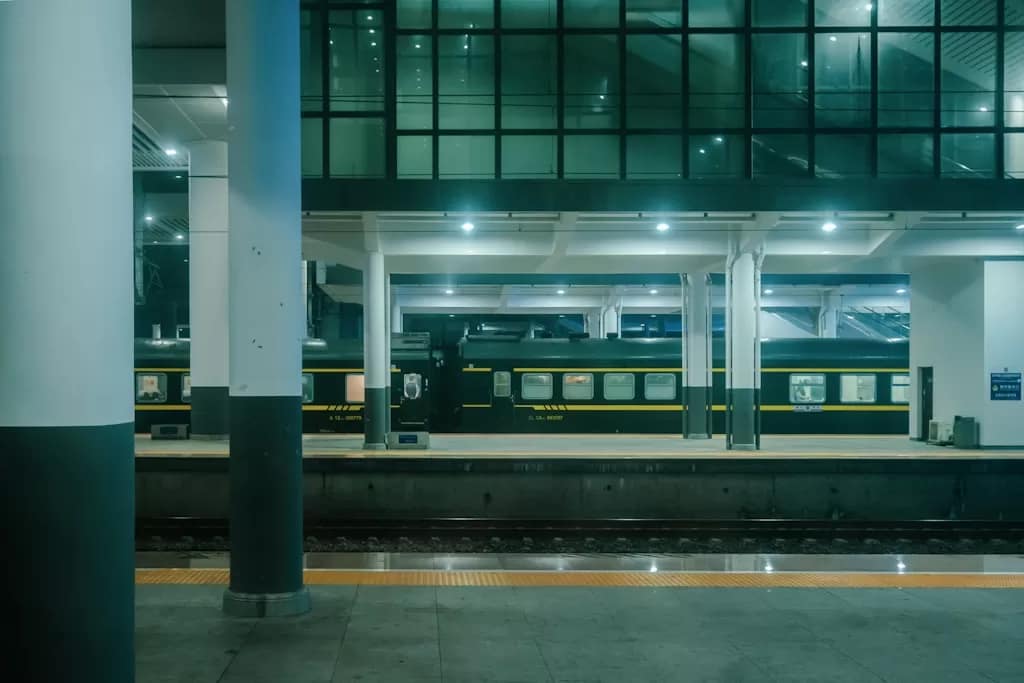
Step 2: Pass through security. Similar to airport security but faster. Put your bags through the X-ray scanner and walk through the metal detector. No need to remove shoes or laptops.
Step 3: Find your waiting hall. Look at your ticket or booking confirmation for the (jiǎnpiàokǒu) number, which indicates your boarding gate. Large stations have massive electronic boards showing train numbers, destinations, gate numbers, and status. The boards cycle between Chinese and English.
Step 4: Board with your passport. When your train is called, join the queue at your gate. The automated gates accept passports—there’s a separate lane (usually the far right or left) for manual document checks. Show your passport to the staff member, and they’ll verify it against the passenger manifest. No physical ticket needed if you booked online.
Step 5: Find your seat. Your ticket shows the carriage number and seat number. Carriage numbers are displayed on the outside of each car. Inside, seat numbers follow the format 12A (window), 12B (middle), 12C (aisle), 12D (aisle), 12F (window) for second class.
On Board: What to Expect
Comfort: Second-class seats are comparable to premium economy on an airline—ample legroom, reclining backs, fold-down trays. First-class seats are wider with more recline. Business class (available on some G-trains) offers lie-flat seats.
Power outlets: Every seat has a power socket (Chinese two-prong + universal). Bring a universal adapter if your plug doesn’t fit the Chinese socket.
WiFi: Most G and D trains have free WiFi, but it requires a Chinese phone number to register. Use your mobile data instead, or download content before boarding.
Food: Trains have a dining car (carriage 5 or 9 on most G-trains) serving hot meals, snacks, and drinks. You can also order food delivery to your seat via the 12306 app (Chinese only). Many travelers bring their own snacks—instant noodles are a time-honored train tradition, and hot water dispensers are available in every carriage.
Bathrooms: Clean by train standards, with both Western and squat toilets. Bring your own tissues and hand sanitizer—they’re not always stocked.
Luggage: Overhead racks and luggage areas at the end of each carriage. There’s no formal size or weight limit for carry-on luggage, but if your suitcase is larger than an airline check-in bag, you might struggle to fit it.
Popular Routes for Travelers
Beijing → Xi’an: 4.5-5.5 hours on G-train. See the Terracotta Warriors after exploring the capital. Perfect 2-city itinerary.
Shanghai → Hangzhou: Just 45-60 minutes on G-train. An easy day trip to see West Lake, tea plantations, and traditional water towns.
Chengdu → Chongqing: 1.5 hours on G-train. Combine pandas and spicy Sichuan food with Chongqing’s stunning cyberpunk skyline.
Guangzhou → Guilin: 2.5 hours on G-train. From the mega-city to the iconic karst mountains—one of China’s most scenic train journeys.
Kunming → Dali → Lijiang: The Yunnan circuit. Connected by D-trains (2-3 hours each leg). This route takes you from the “Spring City” through ancient towns to Jade Dragon Snow Mountain.
5 Money-Saving Tips
1. Book 15 days in advance. Tickets go on sale 15 days before departure. Prices are fixed, but availability is not—popular routes sell out fast.
2. Travel on weekdays. Friday evening and Sunday evening trains are packed with domestic travelers. Tuesday through Thursday mornings are the quietest and cheapest times.
3. Avoid Chinese holidays. During Spring Festival (late January/early February), National Day (October 1-7), and Labor Day (May 1-5), the entire country travels. Tickets become nearly impossible to get, and trains are standing-room only. Plan around these dates.
4. Second class is perfectly fine. Unless you’re over 6’3″ (190 cm) or traveling more than 6 hours, second class is comfortable and costs 30-40% less than first class.
5. Use Trip.com for multi-city bookings. If you’re planning Shanghai → Hangzhou → Huangshan → back, Trip.com’s multi-city search handles the routing automatically, saving hours of manual planning.
Ready to Ride
China’s high-speed rail network is one of the country’s quiet triumphs—fast, affordable, and remarkably easy to use once you know the basics. For more destination inspiration, check out our Guilin Travel Guide 2026, the Guangzhou Travel Guide, and the 3-Day Beijing Classic Group Tour.
China High-Speed Train: Frequently Asked Questions
Q: How do I book China high-speed train tickets as a foreigner in 2026?
Use Trip.com (the easiest English-language option) or the official 12306 app. Booking opens 15 days before departure at 9am Beijing time. Foreign passports are accepted as ID — bring the same passport you used to book. Tickets can also be picked up at any station window with the booking number plus passport.
Q: How early should I book China train tickets?
For popular routes (Beijing-Shanghai, Shanghai-Xi’an, Beijing-Xi’an): book 7-15 days ahead. For peak periods (Golden Week early October, Chinese New Year late January or February, summer school holidays mid-July to late August): book the moment the 15-day window opens. Less popular routes can usually be booked the day before.
Q: How long does Beijing to Shanghai high-speed train take?
The G-class (fastest) trains take 4 hours 18 minutes to 4 hours 55 minutes. Second-class fare is around 553-650 yuan, first-class 933-1083 yuan, business class 1748-1950 yuan. Trains depart roughly every 15-20 minutes during peak hours from Beijing South Station.
Q: What is the difference between G, D, and Z trains in China?
G-trains are the fastest high-speed trains (300-350 km/h), D-trains are slightly slower high-speed (200-250 km/h), and Z-trains are conventional sleepers (120-160 km/h). For tourists, G-trains are almost always the right choice. D-trains are useful on lines without G-train service.
Q: Can I use my passport to enter the train station in China?
Yes. Foreign passports work at all automatic and manual ticket gates at every high-speed rail station. Allow extra time at older stations where the manual passport line moves slower than the Chinese ID self-service gates. Arrive 30-45 minutes before departure.
Q: Is food allowed on China high-speed trains?
Yes. Outside food is permitted, and most stations have decent options before security. On-board carts sell instant noodles, snacks, and basic meals at marked-up prices. Skip the carts unless you are desperate — Beijing and Shanghai stations both have good food courts before the gates.