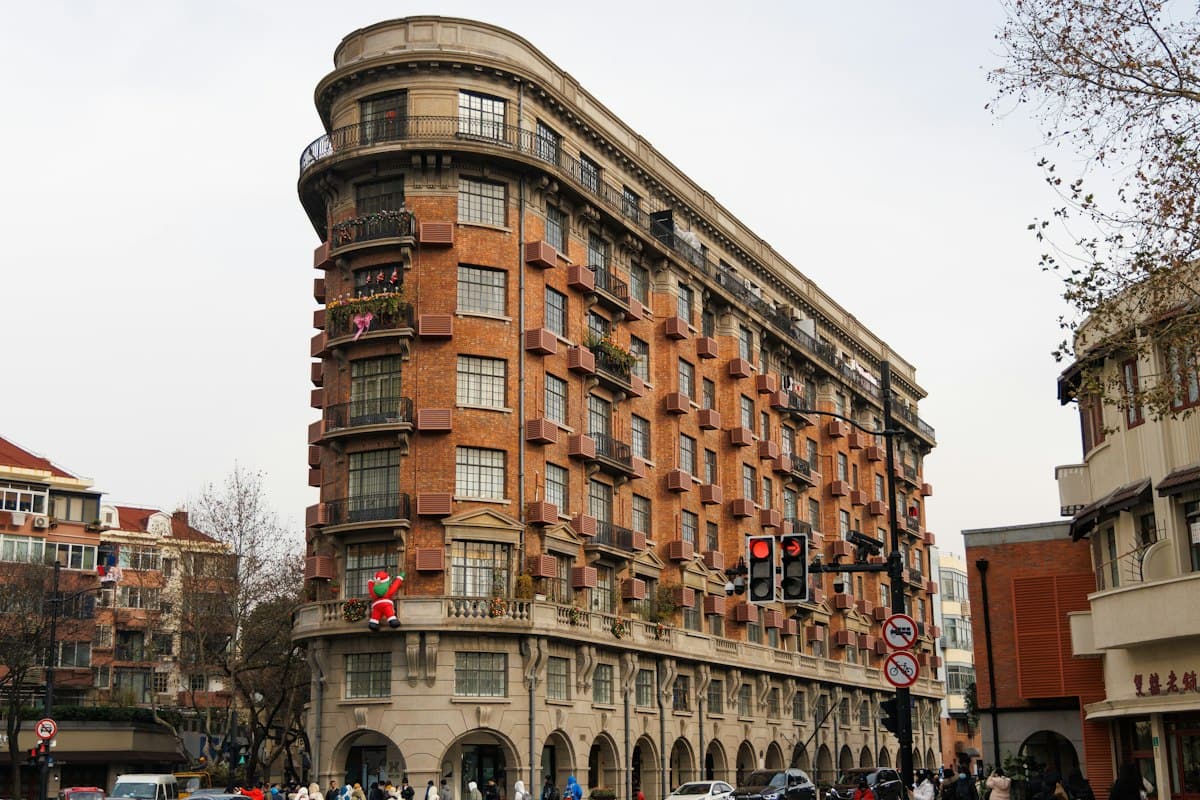
The Shanghai photo you’ve seen a thousand times — the flatiron building with the curved facade, shot from the fork of two tree-lined roads — is Wukang Mansion, and it is genuinely worth seeing. It is also, on a weekend afternoon, a shoulder-to-shoulder queue of people taking the same photograph from the same corner. The good news is that the street it sits on is one of the best urban walks in China, and 90% of the people photographing the building never walk it. This guide covers which lanes to walk, in what order, and the two places that most guides send you to that you should probably skip.
The Quick Verdict: Walk the Triangle, Skip the Two Obvious Stops
The Former French Concession is not one place — it’s roughly 8 square kilometers of streets, and the quality of the walk depends entirely on which four or five you pick. The core walkable triangle is Wukang Road, Anfu Road, and Fenyang Road, with Fuxing Park as the natural end point. Everything within that triangle is worth your afternoon. Two famous stops outside it are, in my experience, not.
| Place | Verdict |
|---|---|
| Wukang Road (武康路) | Walk it. 1.2km of plane trees, 1920s villas, and Wukang Mansion at the north end. Go on a weekday morning. |
| Anfu Road (安福路) | Walk it. The café and small-theatre strip. Best coffee in the neighborhood, and the liveliest street in the evening. |
| Fenyang Road (汾阳路) | Walk it. Quieter, tree-heavy, the Shanghai Conservatory of Music is here — you’ll hear students practising through open windows. |
| Fuxing Park (复兴公园) | Walk it. A French-style garden from the concession era. The best rest stop in the area and almost no tourists. |
| Wuyuan Road (五原路) | Walk it if you want the residential version. Almost no shops, just villas and locals. |
| Tianzifang (田子坊) | Skip. A lane-house block converted entirely into shops. Crowded, repetitive, and no longer representative of anything. |
| Xintiandi (新天地) | Skip unless you want upscale dining. Clean, expensive, and rebuilt rather than preserved — but the Shikumen Open House Museum is the one reason to go. |
That’s the short version. The rest is why each verdict, plus the routing, the timing, and the one small museum most people walk past.
What the Former French Concession Actually Is
The French Concession existed from 1849 to 1943, and at its peak covered about 1,014 hectares — a self-governing foreign-administered zone within Shanghai. What it left behind is the most walkable urban fabric in the city: wide roads planted with plane trees, low-rise villas set back behind garden walls, and lilong — lane housing where multiple families shared a courtyard entrance off a narrow alley.
Three things to know before you walk it:
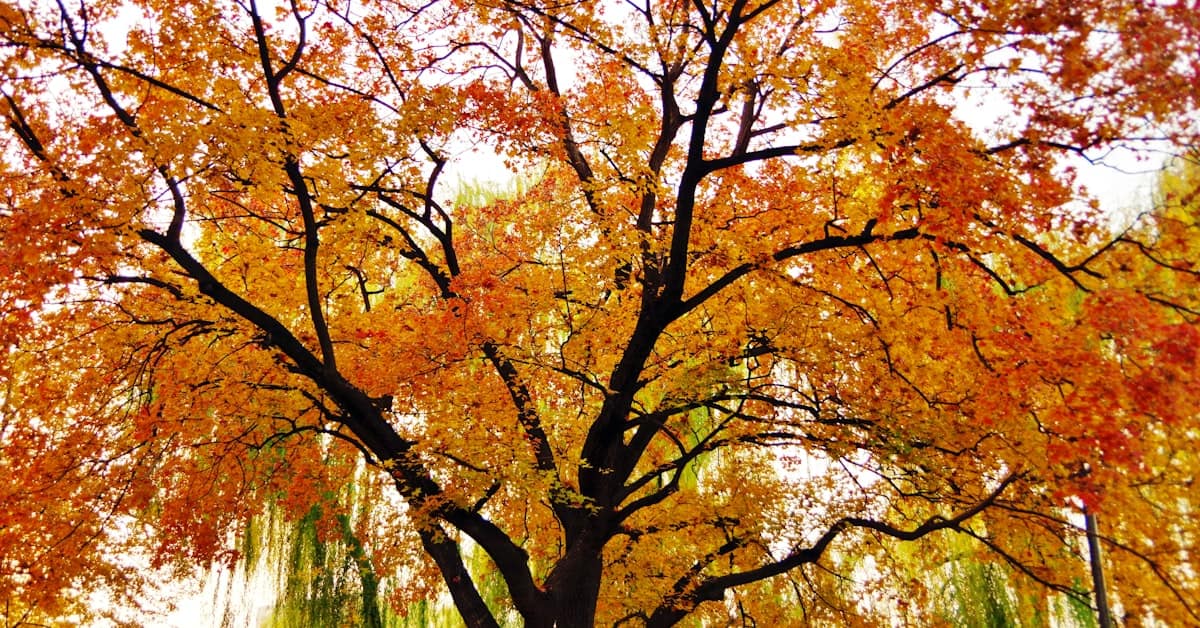
- The plane trees are the neighborhood. Planted by the French municipal administration in the early 1900s, they arch over the roads and create the continuous green tunnel that makes these streets feel unlike anywhere else in Shanghai. In October and November they turn gold, which is the best time of year to walk here
- Most of the villas are private residences. You’ll walk past hundreds of beautiful 1920s and 1930s houses. Almost none are open to the public. Two are: the Former Residence of Soong Ching-ling and a handful of small museums
- The area is still lived in. This isn’t a preserved district like a museum village. People live in these buildings, shop at these shops, and park their scooters against these walls. Behave accordingly — especially on the residential lanes
The Core Walk: Wukang to Fuxing Park
This route is about 3.5 kilometers and takes two to three hours at an unhurried pace, with stops. Start at Jiaotong University metro station (Lines 10 and 11) and walk it in this order.
Wukang Road (武康路)
Wukang Road runs about 1.2 kilometers south from Huashan Road. It is the single best street in the neighborhood, and it is best walked from north to south, because that’s how you approach Wukang Mansion — the wedge-shaped 1924 apartment building designed by the Hungarian-Slovak architect László Hudec, who designed more than 60 buildings in Shanghai including the Park Hotel and the Grand Theatre.
The building sits at the fork where six roads meet, which is why it looks like a ship’s prow. It was originally called the Normandie Apartments and was one of the first apartment buildings in Shanghai to have central heating and elevators. You cannot go inside. You can photograph it from the opposite corner, which is what everyone is doing.
Practical note: the photo corner is genuinely crowded on weekends — expect to wait for a gap. On a weekday morning before 10am you can stand there alone. The building is lit from the east in the morning, so morning is also the better light.
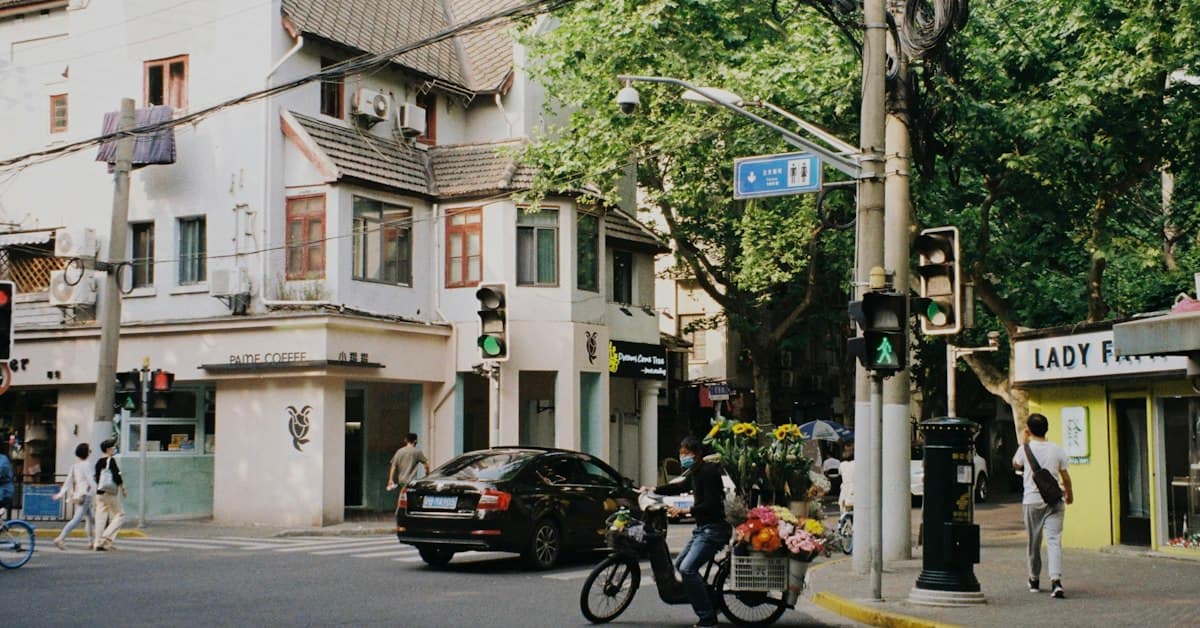
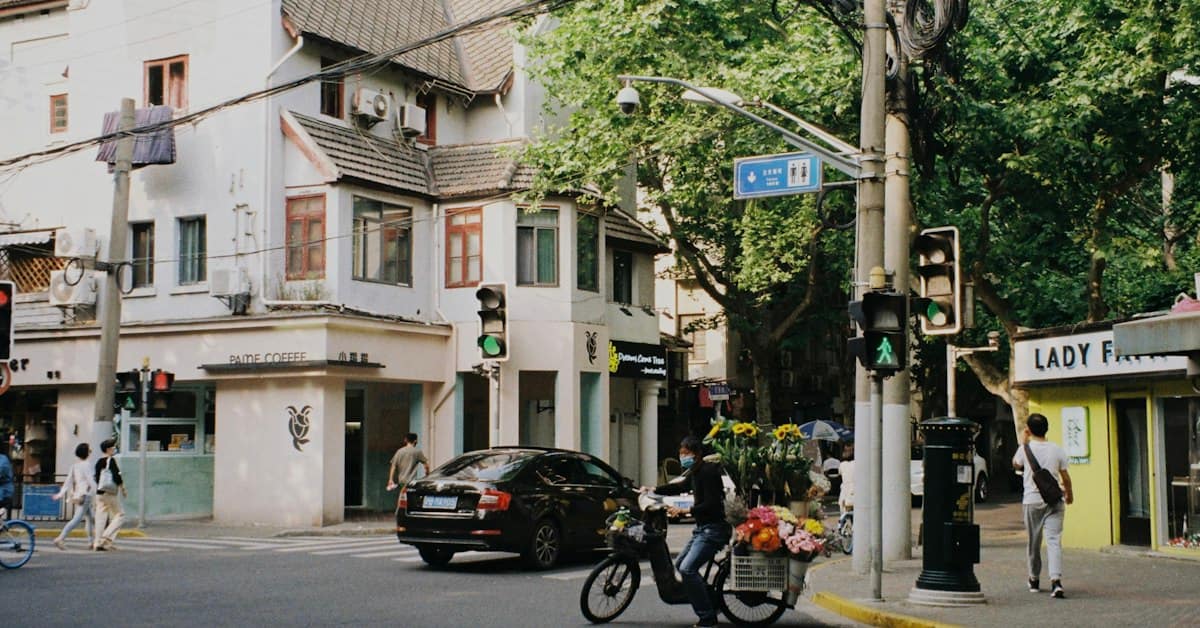
Continue south along Wukang. The street becomes quieter as you move away from the mansion, and the villas get better — bigger gardens, deeper setbacks, more of the 1930s villa vocabulary. Around the middle section there are a few small independent shops and a coffee place or two, but this is mostly a residential street, which is the point.
Anfu Road (安福路)
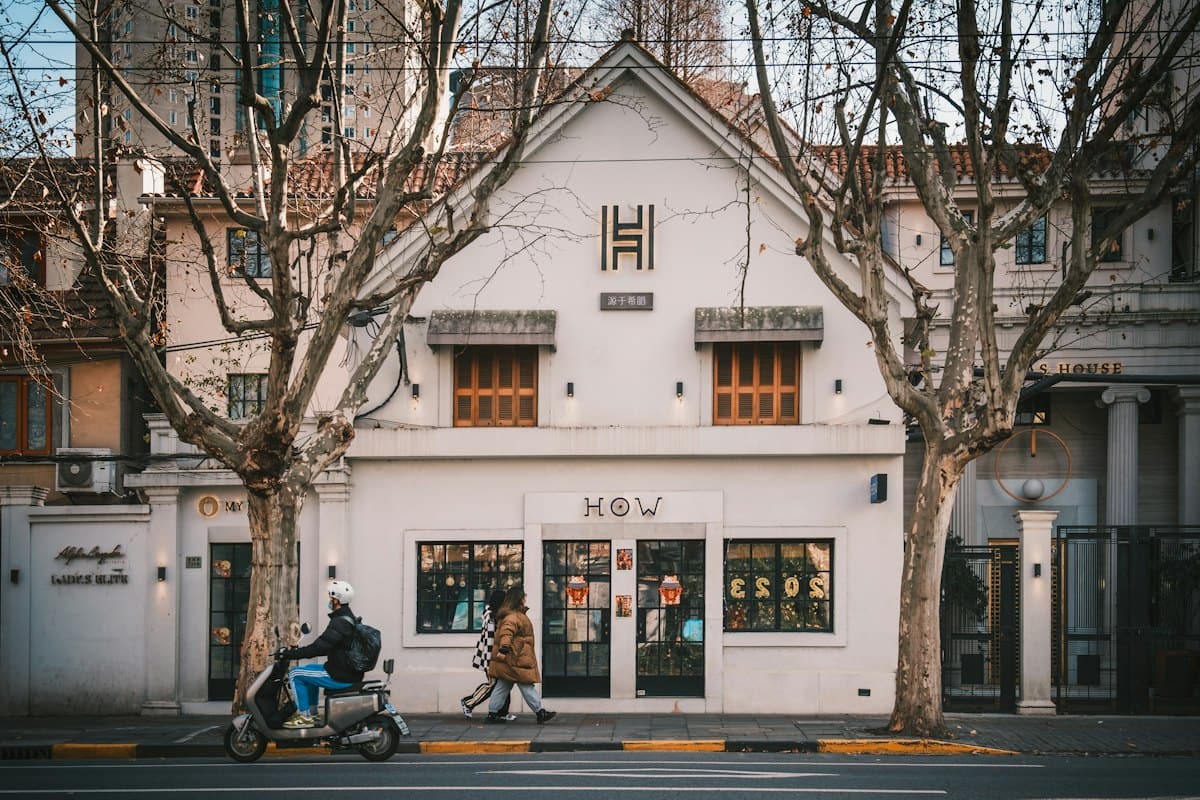
Anfu Road is one block east of Wukang’s southern end, and it is the neighborhood’s social spine. The street is short — about 800 meters — and lined with cafés, a small independent theatre (the Shanghai Dramatic Arts Centre’s annex), bakeries, and a couple of genuinely good restaurants.
In my experience, the coffee here is the best in the neighborhood, and the crowd is a mix of locals, expats who live in the area, and people who came for the cafés rather than the architecture. It’s busy on weekends but not unpleasantly so — the street is wide enough that the crowd doesn’t jam.
Walk it in the late afternoon. The cafés put tables on the pavement, the plane trees filter the light, and it’s the most “this is why people live here” street in Shanghai.
Fenyang Road (汾阳路)
Fenyang Road runs south from the Anfu area toward Fuxing Park. It’s quieter than Anfu, with heavier tree cover and a different character — the Shanghai Conservatory of Music is on this street, and on weekday afternoons you can hear students practising piano and voice through open windows.
This is the kind of detail that doesn’t photograph well and doesn’t appear in any guidebook, and it’s the reason to walk the street rather than take a taxi between the two photo spots.
Fuxing Park (复兴公园)
Fuxing Park is the former French Park — a French-style garden laid out in 1909, with formal parterres, rose beds, and a fountain, surrounded by plane trees. Entry is free.
It is also, functionally, the neighborhood’s living room. Mornings bring tai chi groups, card players, and dancers; afternoons bring office workers on benches. It’s the best place in the area to sit down after three kilometers of walking, and it has almost no international tourists — they’re all at the mansion photo spot or at Tianzifang.
Exit the park at the north gate and you’re a five-minute walk from Xintiandi, if you want to see it.
The Quiet Lanes, If You Have Another Hour
If you want the residential version of the neighborhood — fewer cafés, more villas, almost no one else walking — head west of Wukang Road.
- Wuyuan Road (五原路) — narrow, tree-heavy, almost entirely residential. A few small shops, one good bakery. The best street for seeing what the neighborhood is like when nobody’s performing it
- Xinle Road (新乐路) — has the Russian Orthodox Mission Church (the “Onion Dome” church) at its eastern end, plus a stretch of small independent clothing shops
- Julu Road (巨鹿路) and Changle Road (长乐路) — longer streets running east-west, with a mix of residential blocks and small bars. Ju Lu has a cluster of low-key bars between Shaanxi South Road and Ruijin Road
The Two Famous Stops, and Why I’d Skip Them
Tianzifang (田子坊) — Skip
Tianzifang is a block of lane housing off Taikang Road that was converted into a dense grid of small shops, galleries, and snack stalls. It was genuinely interesting when it started in the mid-2000s. It is now a narrow, crowded labyrinth where every unit sells the same three categories of goods at the same prices.
The lanes are barely two meters wide, so a moderate crowd makes it a slow single-file shuffle with no exit. There’s no view, no architecture worth the trip, and no food that isn’t available better elsewhere. It is the Shanghai equivalent of Beijing’s Nanluoguxiang — same trajectory, same result.
If you go anyway: weekday morning, before 10am, when it’s actually empty enough to walk. It takes 20 minutes.
Xintiandi (新天地) — Conditional skip
Xintiangdi is the opposite approach: instead of converting existing lanes into shops, developers rebuilt a shikumen block as an upscale open-air dining and retail complex. The result is clean, expensive, and pleasant — and about as representative of old Shanghai as a themed resort.
The exception is the Shikumen Open House Museum (around 20 yuan), a preserved lane house furnished as it would have been in the 1920s and 1930s, showing how a family actually lived in these buildings — including the cramped kitchens and shared bathrooms that the restaurants around it have erased. That one room is worth the detour. The rest of Xintiandi isn’t.
Where to Eat and Drink
- Anfu Road — the best concentration of cafés and casual restaurants. Expect 35–60 yuan for a coffee and pastry, 80–150 yuan for a sit-down lunch
- Wukang Road south section — a handful of small bakeries and coffee shops, less crowded than Anfu
- Julu Road — evening bars, lower-key than the Bund, cheaper than Xintiandi
- Local noodle and dumpling shops — one block off the main streets in any direction. A bowl of scallion oil noodles (葱油拌面) runs 15–25 yuan and is the best-value meal in the neighborhood
Practical Logistics
Metro and routing
- Start: Jiaotong University station (交通大学), Lines 10 and 11 — puts you at the north end of Wukang Road
- Alternative start: Changshu Road station (常熟路), Lines 1 and 7 — closer to the Wuyuan/Xinle residential lanes
- End: Fuxing Park, then walk 10 minutes to Xintiandi station (Lines 10 and 13), or continue to Madang Road
- Full route: Wukang Road → Anfu Road → Fenyang Road → Fuxing Park, roughly 3.5 km, two to three hours
When to go
- Best season: October and November. The plane trees turn gold, temperatures sit at 15–22°C, and the light through the canopy is the reason the neighborhood exists on postcards
- Second best: March and April. New leaves, mild weather, fewer people
- Best time of day: weekday mornings for Wukang Road and the mansion photo; late afternoon into evening for Anfu Road
- Avoid: weekend afternoons at the Wukang Mansion corner, and Chinese public holidays entirely
What to bring
- Comfortable shoes — the walking is flat but constant
- A camera with a short telephoto or a phone with a 2x lens — the villa details are what you’ll want to photograph
- Cash or a working WeChat Pay/Alipay account; the small noodle shops and bakeries are QR-code only
Shanghai’s Former French Concession: Frequently Asked Questions
Q: Best street to walk in the French Concession?
Wukang Road (武康路) — 1.2 km of plane trees, 1920s villas, and Wukang Mansion at the north end. Walk north to south, continue to Anfu Road and Fenyang Road, end at Fuxing Park. ~3.5 km, 2-3 hours.
Q: Is Tianzifang worth it?
No. Lane housing converted entirely into small shops; narrow, crowded, repetitive. If you go anyway, weekday morning before 10am — 20 minutes is enough.
Q: What is Wukang Mansion? Can you go inside?
A wedge-shaped 1924 apartment building by László Hudec (originally Normandie Apartments) at the fork of six roads. You cannot go inside — private residence. Best photo from the opposite corner; weekday mornings before 10am.
Q: Best time to visit?
October-November (plane trees gold, 15-22°C). Second best March-April. Weekday mornings for Wukang Road; late afternoon/evening for Anfu Road. Avoid weekend afternoons at the mansion corner and public holidays.
Q: Tianzifang vs Xintiandi?
Tianzifang = existing lanes converted to shops (narrow, crowded). Xintiandi = lanes demolished and rebuilt as upscale dining (clean, expensive, not historic). Both skippable, except the Shikumen Open House Museum in Xintiandi (~20 yuan), which shows how families actually lived.
Q: How to get there by metro?
Jiaotong University (Lines 10/11) for the north end of Wukang Road. Changshu Road (Lines 1/7) for the residential lanes. Finish near Xintiandi station (Lines 10/13).
For the rest of your Shanghai days, the Shanghai travel guide covers the neighborhoods, food and day trips beyond this walk, and the Shanghai architectural story explains the Art Deco, lilong and Pudong layers you’re walking through. If you’ve just landed, the first-day survival guide covers the 144-hour transit visa, airports and hotel zones. And if you’re also doing Beijing, the Beijing hutong guide is the same approach applied to the other city’s old lanes.
Photos courtesy of Unsplash.