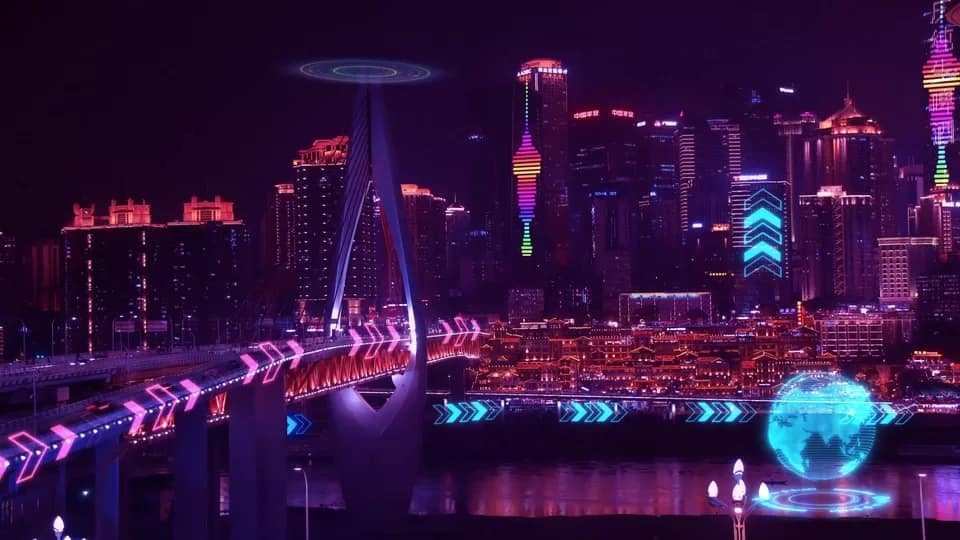
Chongqing is the city where buildings stack on cliffs, light-rail trains tunnel through apartment blocks, and the streets keep changing elevation in ways your map app refuses to acknowledge. It is also, honestly, brutally hot for four months of the year, dense in a way that makes Chengdu feel suburban, and not at all what people expect when they fly in based on the “cyberpunk China” videos. Three days is exactly the right amount of time to spend here — long enough to find the actual neighborhoods, short enough to leave before the humidity becomes your personality. This is the version of a Chongqing trip the videos don’t show you.
Liziba: The Light-Rail Through the Apartment Block
Liziba is the moment that put Chongqing on every traveler’s Instagram in 2018 and hasn’t left since. The Line 2 monorail passes through a residential tower at the sixth-floor level — train enters one wall, glides through the building, exits the other side. It works because the building was designed around the existing rail line, not the other way around. The acoustics inside the apartments are reportedly fine; the city did the engineering carefully.
How to actually see it
- The viewing platform: a small purpose-built deck on the hillside opposite the building. Take Metro Line 2 to Liziba station and follow the signs that say “” (viewing platform). Around a 5-minute walk.
- Best time: 9:30am or 4pm. The platform gets shoulder-to-shoulder between 11am and 3pm and on weekends.
- Cost: free.
- How long: 20 minutes. Watch two or three trains pass, take your photo, leave.
The whole thing is genuinely impressive for about 90 seconds. Don’t build a half-day around it; build it into a route that also covers Hongya Cave (15 minutes away by metro) and the Eling Park viewpoint.
Hongya Cave at Night: The Crowd Problem
Hongya Cave (Hongyadong) is the 11-story stilt-house complex on the Yangtze bank that looks straight out of a Studio Ghibli film when it’s lit up at night. It’s also, by 7pm on any weekend, packed to a degree that makes movement difficult. The shape of the building, the narrow internal corridors, and the staircase choke points concentrate the crowd in a way that’s borderline uncomfortable.
Honestly, the best plan is to view it from the opposite bank, not enter it. Cross the Qiansimen bridge or take Metro Line 6 to Daxigou and walk down to the riverside. The full multi-tier lit-up frontage is the photograph that’s worth taking; the interior is mostly chain restaurants and souvenir floors.
If you do want to go in
- Go on a weekday between 5pm and 6:30pm. Lights come on around sunset (varies by season — 5:30pm in December, 7pm in July). The window between lights-on and the worst of the crowd is roughly 30 minutes.
- Enter from the 11th floor (street level on Cangbai Road, top of the cliff), work down. Reverse direction means fighting upward through the inbound crowd.
- Skip the food on floors 4–9; it’s tourist-priced and bland. The real Chongqing food is elsewhere.
18th Stairs vs Eling Park: Which Viewpoint Wins
Both are city-overview viewpoints. Both involve a climb. They’re not equivalent.
Eling Park — recommended
An old colonial-era hilltop park southwest of the city center with the city’s best two-bridges-and-river panorama. The Two-River Pavilion lookout sits at the southern tip of the ridge and gives you the Jialing River, the Yangtze River, and the confluence in a single frame. The park itself is also a working city park — locals doing tai chi, retirees playing mahjong, almost no foreign tourists. Free entry. Allow 90 minutes. Get there by Metro Line 2 to Daping, then taxi 8 yuan up the hill.
The 18th Stairs — skip unless you have time
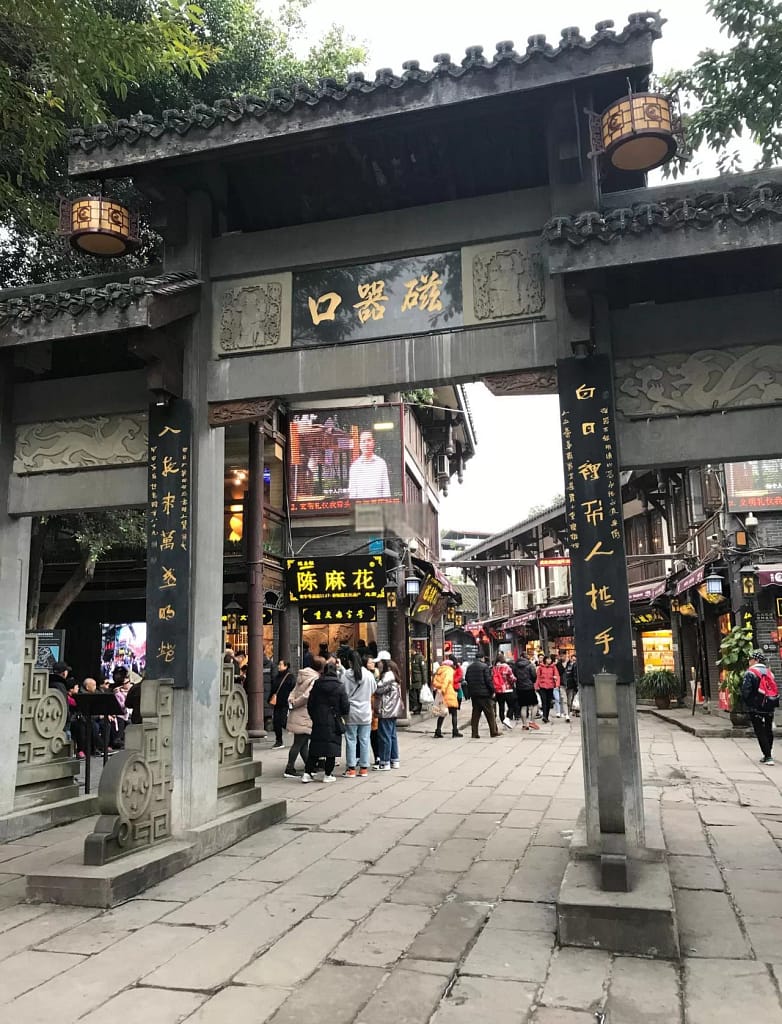
This is the old stairway district between the upper city and the lower river-level wharf, recently reconstructed into a “historic neighborhood” tourist zone. The reconstruction is honestly fine but it’s not the gritty old Chongqing the videos make it look like — those layers of city were demolished and rebuilt with new stone in 2021. It’s worth 30 minutes if you’re walking past, not worth a dedicated trip.
If you only do one viewpoint: Eling Park. If you have a second slot, the Nanshan Yikeshu observation deck on the south bank gives you a longer-distance Pudong-style night photograph (where you see the whole northern bank lit up across the river). Take the cable car across, taxi up.
Real Hotpot Streets (Locals, Not Tourists)
Chongqing is the birthplace of mala hotpot — the numbing, oily, chili-loaded version that conquered the rest of China. Almost every Chongqing food guide will send you to Hongyadong or the touristified streets near the Liberation Monument. Skip those. The mala served at the tourist places is dialed down to maybe 40% of real Chongqing intensity, and the prices are double.
Where locals actually eat
- Bayi Lu area. A short walk west of the Liberation Monument metro, this is the dense backstreet hotpot zone where locals queue. Liuyi Shouzhua and Xiaobin Lou are reliable.
- Jiaochangkou. One metro stop south of Liberation Monument, dozens of hotpot places in a 3-block radius. Local pricing.
- Yangjiaping. Off the tourist path entirely, in the southwest of the city — Metro Line 1. Most authentic, almost no English menus.
The order to give: a divided pot (yuanyang, ) — half spicy, half mild broth. Start with thin-sliced beef, tripe (the local pride dish, maodu ), and luncheon meat. Always order extra rice and a sweet drink. Total per person: 80–120 yuan at a local place, 180–250 yuan at a tourist place.
In my experience the spice level is real. Even people who think they handle Sichuan hotpot well find Chongqing’s version harder — it’s heavier on the numbing peppercorn, lower on the soup-broth dilution. Order a half-spicy pot the first time.

Yangtze Cruise to the Three Gorges: Still Possible?
Yes, but the experience changed significantly after the Three Gorges Dam was completed and the water level rose 175m. The classic 3–4 day cruise from Chongqing downstream to Yichang still runs and remains the standard way to see the gorges — but the gorges themselves are now wider, calmer, and less dramatic than the pre-2003 imagery in older guidebooks. The ride is genuinely scenic; just calibrate expectations downward from “river canyon adventure” toward “comfortable wide-river cruise with daily shore excursions.”
Practical reality
- Direction: Chongqing → Yichang (downstream) is the standard, 3 nights / 4 days. Yichang → Chongqing is upstream, 4–5 nights, more expensive, less popular.
- Boats: two tiers — international cruise ships (President Cruises, Century, Victoria, Yangtze Gold) offering Western-style cabins, English-speaking guides, 3,500–6,500 yuan per person; and domestic boats, basic cabins, Chinese-only, 1,200–2,500 yuan.
- Season: March–November is the comfortable window. April–May and September–October are best for photography (less haze). Winter is operational but cold and gray.
- Shore excursions: Shibaozhai pagoda, the Lesser Three Gorges side trip (smaller boats up a tributary; genuinely the prettiest part of the trip), the dam visitor center at the end.
- End point: you disembark at Yichang, take a 1.5-hour bus or taxi to Yichang East station, then high-speed rail back to Chongqing (4–5 hours) or onward to anywhere east.
Honestly, the Three Gorges cruise is the right add-on if you have 4 extra days and like slow travel. It’s the wrong add-on if you’re on a tight schedule — the time-to-payoff ratio doesn’t compete with a fast Chongqing-Chengdu rail loop. For the broader regional context — Chongqing was formerly part of Sichuan and the culture overlaps deeply — see the Sichuan travel guide.
The Heat Factor: Avoid July and August (Confirmed)
Chongqing is one of China’s “Three Furnaces” — the cities with the worst summer heat. July and August routinely hit 38–42°C with 80%+ humidity, often for two weeks at a stretch without a break. The geography traps the heat: the city sits in a river basin ringed by mountains and the air doesn’t move. Air conditioning is everywhere but stepping out of the metro feels like opening an oven door.
Best months: October–November and March–April. Mid-autumn is the sweet spot — 18–25°C, low humidity, the leaves on the Yangtze hills turning. December–February is doable but gray and damp with a constant low-grade fog that obscures the riverbank views. May and September are workable shoulder seasons.
For broader seasonal context across China see best time to visit China.
How Chongqing Differs from Chengdu
People combine these on a Sichuan trip and assume they’re variants of the same place. They’re not. Both were part of Sichuan province until 1997, both speak the same Sichuanese dialect, both center their food on hotpot and street snacks. But the urban character and pace are completely different.
- Chengdu is flat, spread out, leafy, slow. Tea houses, pandas, late afternoons in parks. The pace rewards staying longer.
- Chongqing is vertical, dense, fast, brutalist. Cliffs, river, neon, the constant sound of metro rumble. The pace rewards moving quickly.
- Hotpot: both claim the original. Chongqing’s is hotter and oilier; Chengdu’s is more aromatic and broth-balanced. Try both.
- Pandas: Chengdu only (the Chengdu Research Base and Dujiangyan). Chongqing has a zoo but it’s not the same.
- Combined trip: 2 hours by high-speed rail between them. 3 days Chongqing + 3 days Chengdu is a strong week. For the Chengdu side see the Chengdu guide.
If you only have time for one and you’ve never been to either: pick Chengdu first. Chongqing is more visually dramatic but Chengdu is the easier introduction to Sichuan, and the food scene is broader.

Getting Around Chongqing
The metro is essential. Chongqing has 10+ metro/monorail lines and the geography means walking between points is genuinely hard — the city has 100m+ elevation changes within a single block. Taxis exist but the city’s verticality means a 1km trip can take 25 minutes around the cliff edges; metro is faster.
- Metro fares: 2–10 yuan depending on distance. Pay via the Alipay or WeChat Pay metro mini-program.
- Don’t trust map apps for walking directions. Google Maps (VPN required) shows stairs but doesn’t know which ones are closed; AMaps (Gaode) is more accurate but Chinese-only. Always check whether your destination is above or below your current elevation.
- The cable car across the Yangtze is genuinely the best 20 yuan ride in the city — it crosses from Xinhua Road to Shangxin Street with a 360° view across the river. Goes every few minutes; queues only get heavy on weekend evenings.
Where to Stay (3-Day Trip)
- Jiefangbei (Liberation Monument) area, Yuzhong district — the city’s central nightlife and shopping zone, walking distance to Hongya Cave and the cable car. Metro hub for everything else. Best base for a first trip.
- Nan’an district (south bank) — quieter, better night views back across to the north shore, but less walkable.
- Shapingba — university district to the northwest, cheaper accommodation, longer metro times to attractions.
3-Day Suggested Route
For a tight, vertical, get-it-done 3-day cyberpunk Chongqing visit:
- Day 1: Liziba light rail (morning) → Hongya Cave riverbank for the lit-up evening view (sunset) → hotpot dinner at Bayi Lu or Jiaochangkou.
- Day 2: Eling Park morning → cable car across the Yangtze → Nanshan Yikeshu observation deck for sunset → late noodles in the Nan’an small streets.
- Day 3: Ciqikou Ancient Town morning (small Ming-Qing era riverside village, half a day) → metro back to Jiaochangkou for a final hotpot lunch → late afternoon train onward (Chengdu is 2 hours; Xi’an 4 hours; Shanghai 8 hours).
For the broader China context — how Chongqing fits into a longer route — see the China itinerary guide, and for the high-speed rail mechanics that make a 3-city Sichuan/Chongqing loop work see the train guide.
Quick Reference: What People Get Wrong in Chongqing
| Common mistake | What actually works |
|---|---|
| Going in July or August because flights are cheap | Go in October or April — the heat is the single biggest determinant of whether you enjoy the city |
| Eating hotpot inside Hongya Cave or near Liberation Monument tourist strip | Walk to Bayi Lu or Jiaochangkou backstreets — local pricing, real spice level, half the cost |
| Entering Hongya Cave on a Saturday at 8pm | View it from the opposite bank, or enter from the top floor on a weekday between 5–6:30pm |
| Trying to walk between attractions to “see the city” | Use the metro — 100m elevation changes inside single blocks make walking exhausting and slow |
| Skipping Eling Park because it isn’t on the Instagram lists | It’s the best free panorama in the city and the only one with no tour crowds |
| Treating Chongqing and Chengdu as interchangeable | Pace them differently — Chongqing 3 days fast, Chengdu 3 days slow; they reward opposite approaches |
One last thing: download the Chongqing Metro app (or use the Gaode/AMap mini-app on WeChat) before you set out each morning. Map services without offline transit data will route you up a stairway that ends at someone’s apartment door, then ask you to “continue 50m northeast” through what is, in fact, an apartment building. Chongqing breaks normal map logic in ways that no other Chinese city does. Plan accordingly.
Photos courtesy of Unsplash.