Where Your Money Goes (And How to Stop It Going There)
The three budget killers in China are international-brand hotels, organized tours, and western restaurants. Avoid all three and you’re already halfway there.Accommodation
Your biggest variable. A Holiday Inn in Shanghai runs $80-120. A perfectly clean Chinese hotel chain — Jinjiang Inn, Hanting, 7 Days Inn — costs $15-30. Hostels with private rooms? $8-20. The catch: book through Chinese apps like Ctrip (Trip.com) or Meituan, not Booking.com. Domestic platform prices are often 30-40% lower.Food
This is where China rewards budget travelers.- Street cart jianbing (egg crepe): ¥8-12 ($1-1.50)
- Lamian (hand-pulled noodles) at a local shop: ¥15-25 ($2-3.50)
- Restaurant meal with beer for two at a non-touristy place: ¥60-100 ($8-14)
Transportation
China’s budget superpower. The high-speed rail network connects almost every city worth visiting.- Beijing to Xi’an: ¥263 ($37), 4.5 hours, 1,200km
- Beijing to Shanghai: ¥553 ($77) — or split into two legs with overnight trains
- City subways: ¥2-7 ($0.30-1) per ride
- Taxis: start at ¥10-14 ($1.40-2), most inner-city rides under ¥25 ($3.50)

The $50-a-Day Breakdown
Here’s what a typical day actually looks like on a tight budget:Accommodation: $10-15
Dorm bed in a hostel ($8-12) or a private room at a budget hotel ($15-25 if splitting with someone). Hostels are your best bet — they often have English-speaking staff who can help you book train tickets and navigate WeChat Pay.Food: $10-15
- Breakfast from a street cart: ¥8-15
- Lunch at a small noodle shop: ¥15-25
- Dinner at a local restaurant: ¥30-50
- Snacks and a beer or two: ¥10-20
Transportation: $5-10
Subway rides (¥2-7 each), the occasional taxi (¥15-30), and amortized intercity train costs. If you’re doing a big train jump that day, your transport budget spikes — but your accommodation drops to zero on an overnight train.Attractions: $5-10
This varies wildly. The Forbidden City is ¥60 ($8.50). A random temple in a second-tier city might be ¥5 ($0.70) or free. Many parks are free before 7am (when locals do their morning exercises — worth seeing anyway). Budget more in Beijing and Shanghai, less everywhere else.Buffer: $5-10
Water (¥2 for a big bottle), SIM card data, the occasional coffee that isn’t instant (¥15-30 at a real cafe, or ¥9 at Luckin Coffee — China’s answer to Starbucks at a third of the price). Total: $35-60 per day. Hit the lower end in smaller cities, the higher end in Shanghai and Beijing.The Apps You Need Before You Land
You cannot travel China on a budget without the right apps. Cash is dying — street vendors scan QR codes. Install these before your flight:- Alipay — Set it up with your foreign credit card (the tourist mode works now). You’ll use it for everything from subway rides to street food to hotel bookings.
- WeChat — Not just for messaging. WeChat Pay is the other half of China’s payment system, and you need it for mini-programs that don’t work with Alipay.
- Trip.com (Ctrip) — Book trains, flights, and hotels. Often cheaper than Booking.com for domestic properties.
- Amap (Gaode) — Google Maps is unreliable in China. Amap works offline and gives you accurate subway directions.
- Dianping — China’s Yelp. Find cheap local restaurants by filtering for high ratings and low prices.

Where It Gets Complicated
A few things will test your budget no matter what you do:The Great Firewall
You need a VPN. Good ones cost $3-8/month. Free VPNs don’t work reliably in China — the government blocks them constantly. Set it up before you arrive.Visa Fees
A standard Chinese tourist visa costs $140-160 depending on your nationality and where you apply. This is a fixed cost you can’t avoid. The 144-hour transit visa is free but limits you to one region — if your itinerary fits, use it. For full visa details, see our China Visa Guide.Peak Season Surcharges
Chinese New Year (January/February), Golden Week (October 1-7), and summer holidays (July-August) are when domestic travel explodes. Hotel prices double or triple. Train tickets sell out within minutes of release. If you can travel in March-May or September-November, do it — the weather’s better and everything’s cheaper.Scams
The tea house scam in Shanghai and Beijing targets foreigners specifically — a friendly “student” invites you to practice English at a tea house, and you get hit with a $200 bill. Just say no to anyone who approaches you on the street wanting to practice English. Real Chinese people who want to practice English use apps, not Wangfujing Street.Sample Two-Week Budget Itinerary
Want to see how this all adds up in practice? Here’s a realistic two-week route through China’s greatest hits, priced out:Days 1-4: Beijing — ~$350
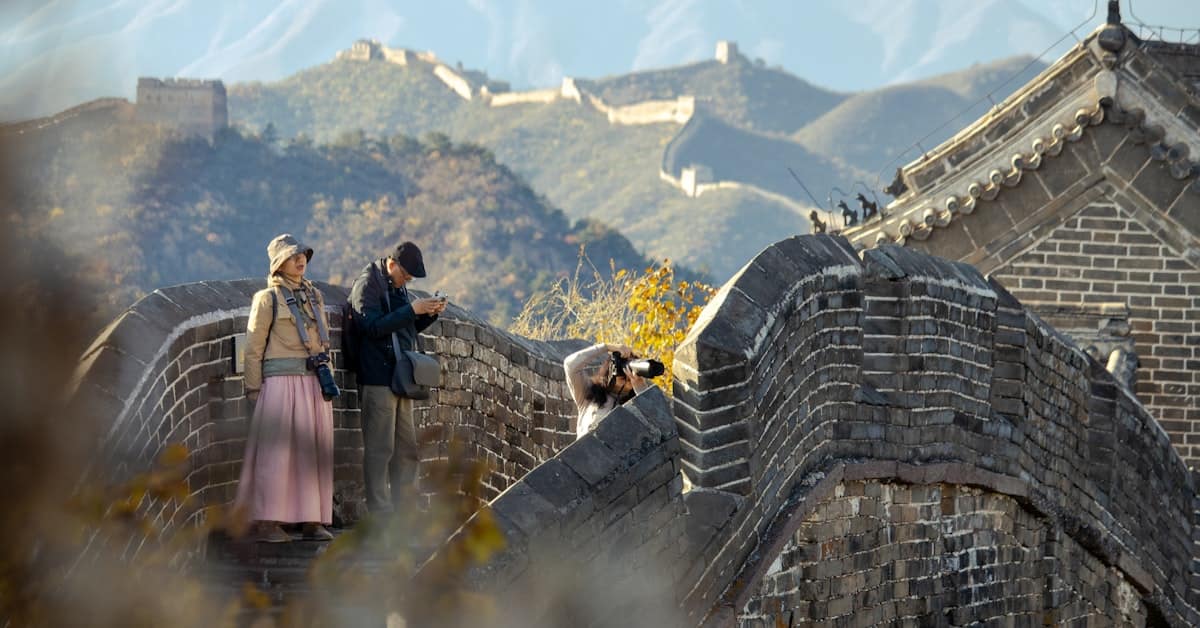
- Forbidden City (¥60), Temple of Heaven (¥15), Great Wall at Mutianyu (bus ¥12 + cable car ¥140 — or hike for free), Summer Palace (¥30)
- Street food for most meals
- Budget hotel $20/night
Days 5-7: Xi’an — ~$230
- Bullet train from Beijing (¥263/$37, 4.5 hrs)
- Terracotta Warriors (¥120 — the one splurge worth making)
- City Wall bike ride (¥54 + ¥45 rental)
- Muslim Quarter food (cheap and incredible)
- Hostel $12/night
Days 8-10: Chengdu — ~$220
- Bullet train Xi’an to Chengdu (¥263/$37, 4 hrs)
- Panda Base (¥55 — go at 7:30am)
- Hotpot at a local place (¥60-80/person)
- Wuhou Shrine (¥50)
- Budget hotel $18/night
Days 11-14: Shanghai — ~$280
- Flight Chengdu to Shanghai (book on Trip.com, ¥400-600/$56-84 if you book ahead)
- The Bund (free), Yu Garden (¥40)
- Street food on Yunnan Road, subway everywhere
- Budget hotel $25/night
Cheap Doesn’t Mean Missing Out
Here’s the thing about budget travel in China: the cheap stuff is often the best stuff. The $2 bowl of noodles from a hole-in-the-wall is better than the $15 meal at the tourist restaurant. The free park where grandpas do tai chi at dawn is more memorable than the ¥200 cultural show. The overnight train where you share instant noodles with strangers beats the first-class flight.

Quick Budget Tips That Actually Work
- Book trains 15 days in advance on Trip.com — that’s when tickets are released and you actually have a shot at the cheap ones
- Eat breakfast at street carts, not hotels. Jianbing > hotel buffet, and I will die on this hill
- Skip the Bund river cruise in Shanghai (¥150). Take the public ferry across the Huangpu for ¥2 instead — same views, 75 times cheaper
- Go to Mutianyu instead of Badaling for the Great Wall. Less crowded, and the bus + cable car combo is cheaper than any tour
- Hotel breakfast buffets in China are usually bad. Spend that money on street food instead
- Second-tier cities (Chengdu, Xi’an, Changsha, Kunming) are 30-50% cheaper than Beijing/Shanghai and often more interesting
- Negotiate hotel prices directly — walk in and ask for the best rate. Works surprisingly often at Chinese hotels
- Buy a China Unicom SIM at the airport (¥100-200 for 7-30 days with data). Don’t bother with international roaming
- ATM withdrawals from Chinese banks charge minimal fees — avoid the currency exchange counters at airports
- Download offline maps in Amap before you leave WiFi range. Cell signal can be spotty in rural areas
China Budget Travel: Frequently Asked Questions
Q: Can you really travel China for under $50 a day?
Yes, comfortably, in 2026. Budget breakdown: $15-25 hostel/budget hotel, $10-15 food (mix of street food and small restaurants), $5-10 transport, $5-10 attractions and incidentals. Tier-2 and tier-3 cities push the math even lower — Chengdu, Xi’an, and Kunming are especially good for budget travel.
Q: What’s the cheapest way to get around China?
High-speed train second-class for routes between major cities (200-700 yuan depending on distance). Sleeper trains for longer routes save you a hotel night. Domestic flights are surprisingly cheap last-minute (often cheaper than the train) — check Ctrip and Skyscanner together.
Q: Are hostels in China decent for budget travel?
Better than expected. Mid-range hostels in Beijing, Shanghai, Chengdu, and Yangshuo run 80-150 yuan per night for a dorm bed. Many have private rooms for 200-350 yuan that beat 3-star hotel prices. Check English reviews on Booking.com and Hostelworld — Chinese-language hostel platforms are not foreigner-friendly.
Q: Where in China is the cheapest for tourists?
Yunnan (Kunming, Dali, Lijiang) and Sichuan (Chengdu, Leshan) are the top budget destinations. Daily budgets of $30-40 are realistic. Beijing and Shanghai add roughly $10-15 per day on top. Tibet and Xinjiang are the most expensive due to permits, distances, and the requirement of guided travel in Tibet.
Q: Do I need cash for budget travel in China?
Less than you think. WeChat Pay and Alipay both accept foreign cards (Visa/Mastercard) since 2023, and 95% of vendors take them. Bring 1,000-2,000 yuan in cash as backup for rural areas, small towns, and the occasional vendor whose QR code system is broken.
Q: Is China cheap for backpackers in 2026?
Significantly cheaper than Japan, South Korea, Thailand (post-2022 inflation), or anywhere in Western Europe. Comparable to Vietnam and Indonesia for daily costs, with much better infrastructure. The 144-hour transit visa-free option (for many nationalities) makes a budget China stop easy to add to a Southeast Asia loop.