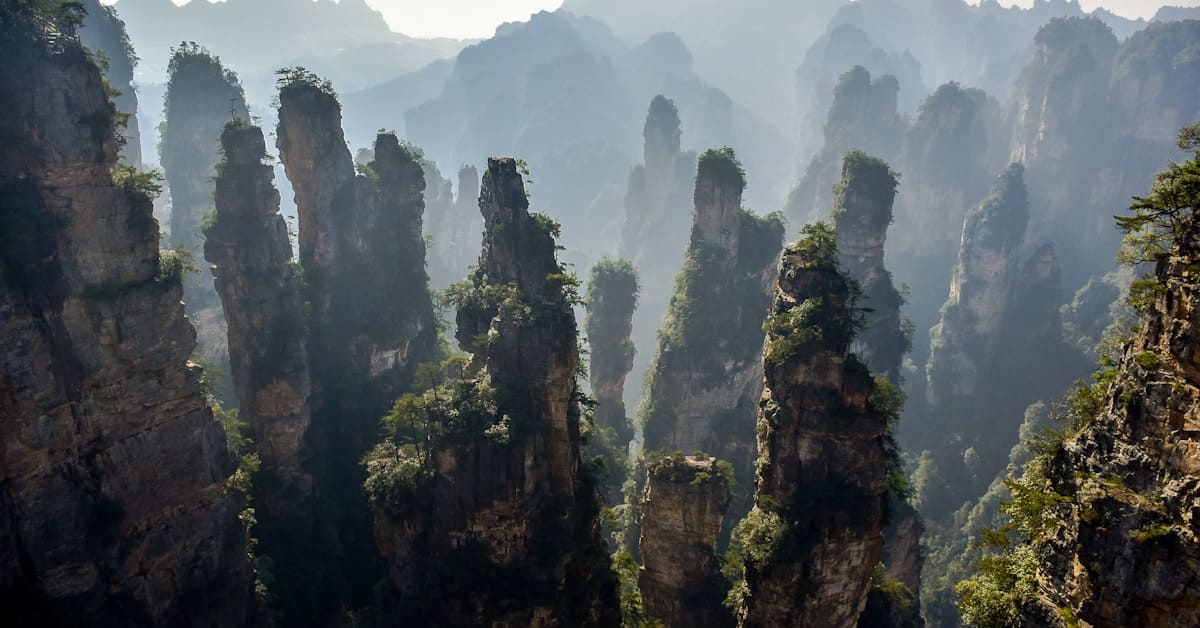
Zhangjiajie does one thing better than almost anywhere else in China: it makes you stop walking and stare. The sandstone pillars in Wulingyuan Scenic Area are the ones James Cameron used as visual reference for Avatar, and that fact alone now drives most international visitors here. The Avatar marketing brought the crowds, but the geology was doing this for 380 million years before any film existed.
The thing nobody tells you upfront: Zhangjiajie isn’t one park. It’s a sprawling 690-square-kilometer cluster of three separate sub-areas joined by an environmental shuttle bus network, plus a fourth area (Tianmen Mountain) located 32km away and not connected to the main park ticket at all. Show up without a plan and you will spend the first day just figuring out where you are. Here is how to actually use this place.

The Four Areas: What They Actually Are, and Which One to Prioritize
When people say “Zhangjiajie,” they usually mean one of four distinct places. Getting this clear before you arrive saves you a half day of confusion at the ticket gate.
Wulingyuan Scenic Area is the big one. It is the UNESCO-listed national park containing Yuanjiajie, Tianzi Mountain, and Yangjiajie sub-zones. One ticket (228 yuan, valid 4 days) covers everything inside. This is where 80% of your photos will come from, and where you should plan to spend at least two full days.
Yuanjiajie is a sub-zone of Wulingyuan, not a separate park. It contains the “Avatar Hallelujah Mountain” pillar and the Number One Bridge Under Heaven viewpoint. It is the single most photographed area, and it gets the heaviest crowds between 10am and 2pm. Reach it via the Bailong Elevator or by hiking up from the Golden Whip Stream valley floor.
Tianzi Mountain is another sub-zone inside Wulingyuan, on the northern side. The viewpoints here (especially West Sea Stone Forest and Helong Park) are wider and less compressed than Yuanjiajie. In my experience, it photographs better in late afternoon when the western light catches the pillars side-on. Reach it via the Tianzi Mountain Cableway or the long staircase from Shentang Bay.
Tianmen Mountain is the cable-car mountain with the natural arch (“Heaven’s Gate”) and the cliffside glass walkway. It is 32km from Wulingyuan, has its own ticket (258 yuan including cable car), and is best done as a day trip from Zhangjiajie city, not from inside the park. Do not confuse it with Tianzi Mountain — different mountain, different ticket, different day.
If you have three days, do two days inside Wulingyuan and one day at Tianmen Mountain. Honestly, the glass bridge at Zhangjiajie Grand Canyon (yet another separate ticket, 138 yuan) is skippable unless you are specifically there for the Instagram shot.
Wulingyuan vs Tianzi vs Yuanjiajie: A Quick Decision Tree
If you only have one day inside the park: enter via Wulingyuan gate, take the Bailong Elevator up, spend the morning at Yuanjiajie (Avatar pillar + Number One Bridge), then shuttle to Tianzi Mountain for late afternoon light. Exit via Tianzi Mountain Cableway.
If you have two days: same as above on day one, then dedicate day two to Yangjiajie (the quietest sub-zone, with the Tianbo Mansion viewpoint) and the Golden Whip Stream valley walk. The valley walk takes 2.5 hours one way and is the only flat thing in the park.
The Bailong Elevator: Queue Tactics That Actually Work
The Bailong Elevator is a 326-meter glass elevator bolted to a cliff face — three cabs, 50 people per ride, 88 seconds top to bottom. It is the fastest way from the valley floor up to Yuanjiajie. It is also the single worst bottleneck in the park.
Ticket cost: 72 yuan one-way (as of 2026). You buy it separately from the park entrance ticket, at the elevator base. Bring small bills or have WeChat Pay set up — the cash window has one person and a 30-person queue.
The honest answer on queue times: between 9:30am and 12:30pm in peak season (April–October weekends, all of Golden Week, and the summer school holiday in July–August), the wait can hit 90 minutes going up. Going down in late afternoon is faster — usually 20–30 minutes — because most domestic tour groups have already left.
There are three ways to dodge the worst of it:
- Reverse the elevator: Take the bus shuttle from Wujiayu (the high-altitude shuttle hub near Yuanjiajie) down to the valley in the morning, walk the Golden Whip Stream, then ride the elevator up at 2pm when the morning surge has cleared.
- Skip it entirely: Hike the 3,800 stairs from the Stream up to Yuanjiajie. It takes 2.5 hours, you will be wrecked, but you will be at the top viewpoints when the elevator crowds are still in line.
- Use the cableways instead: The Yangjiajie Cableway (76 yuan) and Tianzi Mountain Cableway (72 yuan) move people up to other sub-zones with rarely more than a 20-minute wait. From Yangjiajie or Tianzi you can shuttle across to Yuanjiajie on the free park bus.
I have seen this go wrong when people insist on the elevator because “it is the famous one.” It is famous because it is unusual engineering, not because the view from inside is better than a cableway. Save it for the descent.
The Glass Bridge: When to Go, When to Skip
There are actually two glass attractions in the Zhangjiajie area, and people confuse them constantly:
Zhangjiajie Grand Canyon Glass Bridge (430m long, 300m above the canyon floor, 138 yuan) is outside Wulingyuan park, about 30km away in a separate scenic area. It is the one in most travel videos. Daily visitor cap is 8,000, online booking only via WeChat mini-program (search “”), and slots for weekends in peak season sell out 3–5 days in advance.
Tianmen Mountain Glass Skywalk is a 60-meter cliffside walkway included with the Tianmen Mountain ticket. It is shorter, narrower, and arguably more dramatic because you can see your feet hanging over a 1,400m drop. No separate booking needed beyond the main ticket.
Best time to walk the Grand Canyon bridge: first entry slot (8:00–10:00am). The bridge sways noticeably when crowds gather mid-day, and the safety attendants will rush you across during peak periods. The 8am slot has perhaps 200 people on it at once — comfortable, with time to actually look down.
Honestly, if you only have time for one glass experience, do the Tianmen Mountain Skywalk. It is included in a ticket you should buy anyway, the views are better, and you do not have to make a separate 60km round trip from town.

Getting There: Zhangjiajie Hehua Airport vs Changsha High-Speed Train
Zhangjiajie Hehua Airport (DYG) is 5km from Zhangjiajie city. It has direct flights from Beijing, Shanghai, Guangzhou, Chongqing, Xi’an, and a handful of regional cities. International connections are limited — most foreign visitors transfer through one of those hubs. Flight time from Beijing is about 2h 40m.
The high-speed train alternative goes through Changsha. Beijing West to Changsha South: 5h 30m on the G-class. Changsha South to Zhangjiajie West: another 2h 25m on the newer G-line that opened in 2021. Total journey: roughly 8 hours door to door, including the transfer.
When to fly: from any city more than 1,500km away, or if you are short on time. The fare to Zhangjiajie is often cheaper than people expect — book on Trip.com 3–4 weeks ahead and Shanghai–Zhangjiajie regularly comes in under 600 yuan one-way.
When to take the train: if you are already in Wuhan, Changsha, Guilin, or somewhere in central-southern China. The new G-line via Changsha makes Zhangjiajie a workable rail destination, which it was not five years ago. Book via the China High-Speed Train Travel Guide approach — same rules apply here.
From Zhangjiajie city or airport, the trip to Wulingyuan park entrance takes about 50 minutes on the K6 bus (12 yuan) or 90 minutes via DiDi (about 100 yuan as of 2026). Most hotels inside the park gate run private shuttles for guests booking two or more nights — ask before you arrive.
Hotels: Inside the Park or in Zhangjiajie City?
Stay inside the park if you want to catch sunrise at the viewpoints. The shuttle buses do not start running until 7am, and the gate from outside does not open until then either. By the time outside-park guests reach Tianzi Mountain, you have already had it to yourself for 30 minutes.
The two main villages inside Wulingyuan are Yuanjiajie village (small, basic, walkable to the Avatar pillar in 15 minutes) and Tianzi Mountain village (slightly larger, with a cluster of mid-range hotels). Neither has chain-hotel quality — these are family-run guesthouses with mixed standards. Read recent reviews carefully. Budget 250–450 yuan per night for a clean double room.
Stay in Zhangjiajie city if you want to combine the park with Tianmen Mountain, or if you prioritize hotel quality over sunrise. Zhangjiajie city has international chains (Hilton Garden Inn, Crowne Plaza) and the train station / airport are both 15–20 minutes away. The trade-off: every park day starts with a 50-minute commute.
The middle option: Wulingyuan town, just outside the park’s south gate. It has the best concentration of comfortable boutique hotels (some opened in 2023–2024 specifically for international visitors), is 5 minutes by taxi to the gate, and avoids both the basic inside-park accommodations and the long commute from Zhangjiajie city. For most first-timers, this is the sweet spot. See the broader China Hotel Guide for Foreigners for booking platform notes.

Best Months to Visit (and the One to Avoid)
The honest answer: late April through early June, or late September through mid-November. Spring gives you green canopy, mist clinging to the pillars in early morning, and tolerable temperatures (15–22°C). Autumn gives you sharper visibility, occasional red-leaf color in the upper sub-zones, and the lowest humidity of the year.
Summer (July–August) is hot (32–35°C), humid, often hazy, and crowded with domestic family travelers on school break. Thunderstorms in the afternoon are common and the cableways shut down for safety when lightning is nearby. Go only if you have no other option.
Winter (December–February) is the sleeper season. Snow on the pillars is genuinely spectacular and the park is mostly empty. The catch: temperatures swing between –5 and 5°C, some smaller trails close, and the Tianmen Mountain cableway occasionally closes after heavy snow. Bring layers and check forecasts the day before. For broader seasonal context, see the Best Time to Visit China overview.
Absolutely avoid: October 1–7 (National Day Golden Week) and the first week of May (Labour Day). Both holidays pump 60,000+ daily visitors into a park already operating near capacity. Hotel prices triple and some viewpoints are closed for crowd control.
Photography Spots Worth the Detour
If you came here for photos, four spots produce the shots people actually share:
Number One Bridge Under Heaven (Yuanjiajie): a natural stone arch spanning two pillars. Shoot at 9–10am for direct light on the arch face. Tripods allowed but expect to wait 5–10 minutes for a clear frame in shoulder season.
Hallelujah Mountain Viewpoint (Yuanjiajie): the official “Avatar pillar” with the namesake sign. Honestly, the view 200m further down the path is better — fewer people, same pillar, no sign in your frame. Walk past the crowd.
West Sea Stone Forest (Tianzi Mountain): a 360-degree platform over a dense cluster of pillars. Best light: 4:30–6:00pm in summer, 3:30–5:00pm in winter. This is the photo you have probably seen but couldn’t place.
Tianbo Mansion (Yangjiajie): hardest to reach (requires a serious stair climb after the cableway), but you will have it to yourself outside Golden Week. Mist banks roll through in early morning here more reliably than anywhere else in the park.
Putting It Into a 3-Day Itinerary
This is the structure that works for first-time visitors who want to see the park properly without a tour group:
Day 1 — Arrive + Tianmen Mountain. Land at Zhangjiajie Hehua in the morning. Drop bags at a Zhangjiajie city hotel. Take the cable car up Tianmen Mountain (the world’s longest passenger cableway at 7.5km) by midday. Do the cliffside walkways and glass skywalk. Descend via the 99-bend road. Evening: dinner in Zhangjiajie city, transfer next morning to Wulingyuan.
Day 2 — Wulingyuan core (Yuanjiajie + Tianzi). Enter via Wulingyuan gate at 7:30am. Take the park shuttle to Bailong Elevator (or hike the Stream if you have the legs). Spend morning at Yuanjiajie. Lunch at the simple noodle stalls in Yuanjiajie village. Afternoon shuttle to Tianzi Mountain for West Sea Stone Forest at golden hour.
Day 3 — Yangjiajie + valley walk. Earlier start than day 2 (catch the 7am shuttle). Yangjiajie Cableway up. Tianbo Mansion before the day groups arrive. Descend in early afternoon and walk the Golden Whip Stream end-to-end (2.5 hours, mostly flat, riverside). Exit the park at the Yuanjiajie gate by 5pm. Transfer to airport or train station.
For how Zhangjiajie slots into a longer national route, the China Itinerary Guide shows how to combine it with Chengdu (panda base + Sichuan) and Guilin (karst landscape variation).

Common Mistakes vs What Actually Works
| The trap most first-timers fall into | What I do now |
|---|---|
| Buying a single one-day Wulingyuan ticket and trying to see everything | Two-day minimum. The ticket is already valid 4 days — use the time. |
| Insisting on the Bailong Elevator at 10am because it is famous | Reverse it: shuttle down in the morning, ride the elevator up at 2pm |
| Staying in Zhangjiajie city to save money, commuting daily | Sleep in Wulingyuan town or inside the park, save 100 minutes a day |
| Confusing Tianzi Mountain (inside park) with Tianmen Mountain (separate ticket, 32km away) | Treat Tianmen as a dedicated day before or after the main park |
| Showing up at the Grand Canyon glass bridge on weekend without booking | Reserve via the WeChat mini-program 3–5 days in advance, or skip for the Tianmen skywalk |
| Visiting during Oct 1–7 because it lines up with vacation days | Move the trip by one week if possible — the difference in crowds is the difference between enjoyable and miserable |
One Last Practical Note
The shuttle bus system inside Wulingyuan is free with your park ticket, but the buses do not follow a posted schedule — they run on demand, leaving when full. The longest walk between any two stops is about 30 minutes. Download a map screenshot of the park before you go: GPS works fine, but data signal in the deeper sub-zones is patchy, and the official park map kiosks have English only on a quarter of the signs. If you only carry one offline reference, make it the bus route map at the Wulingyuan gate information desk — they hand it out free in English, and it saves more disorientation than any guidebook.
Photos courtesy of Unsplash.